M5Bar
M5Bar is a widget that can be used to create progress bars in the user interface. It displays values within a specified range using a visual bar indicator. The bar can be customized with different colors, gradients, and can optionally display the current value as text.
UiFlow2 Example
Temperature meter
Open the cores3_temperature_meter_example.m5f2 project in UiFlow2.
This example demonstrates how to create a temperature meter that shows the current temperature.
UiFlow2 Code Block:
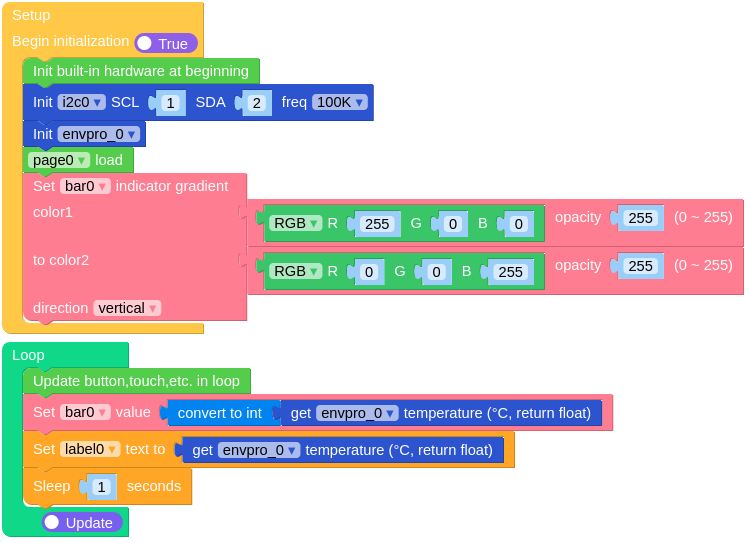
Example output:
None
MicroPython Example
Temperature meter
This example demonstrates how to create a temperature meter that shows the current temperature.
MicroPython Code Block:
 1# SPDX-FileCopyrightText: 2025 M5Stack Technology CO LTD
 2#
 3# SPDX-License-Identifier: MIT
 4
 5import os, sys, io
 6import M5
 7from M5 import *
 8import m5ui
 9import lvgl as lv
10from hardware import I2C
11from hardware import Pin
12from unit import ENVPROUnit
13import time
14
15
16page0 = None
17bar0 = None
18label0 = None
19i2c0 = None
20envpro_0 = None
21
22
23def setup():
24    global page0, bar0, label0, i2c0, envpro_0
25
26    M5.begin()
27    Widgets.setRotation(1)
28    m5ui.init()
29    page0 = m5ui.M5Page(bg_c=0xFFFFFF)
30    bar0 = m5ui.M5Bar(
31        x=148,
32        y=21,
33        w=20,
34        h=200,
35        min_value=0,
36        max_value=50,
37        value=25,
38        bg_c=0x2193F3,
39        color=0x2193F3,
40        parent=page0,
41    )
42    label0 = m5ui.M5Label(
43        "label0",
44        x=181,
45        y=112,
46        text_c=0x000000,
47        bg_c=0xFFFFFF,
48        bg_opa=0,
49        font=lv.font_montserrat_14,
50        parent=page0,
51    )
52
53    i2c0 = I2C(0, scl=Pin(1), sda=Pin(2), freq=100000)
54    envpro_0 = ENVPROUnit(i2c0)
55    page0.screen_load()
56    bar0.set_bg_grad_color(
57        0xFF0000, 255, 0x0000FF, 255, lv.GRAD_DIR.VER, lv.PART.INDICATOR | lv.STATE.DEFAULT
58    )
59
60
61def loop():
62    global page0, bar0, label0, i2c0, envpro_0
63    M5.update()
64    bar0.set_value(int(envpro_0.get_temperature()), True)
65    label0.set_text(str(envpro_0.get_temperature()))
66    time.sleep(1)
67
68
69if __name__ == "__main__":
70    try:
71        setup()
72        while True:
73            loop()
74    except (Exception, KeyboardInterrupt) as e:
75        try:
76            m5ui.deinit()
77            from utility import print_error_msg
78
79            print_error_msg(e)
80        except ImportError:
81            print("please update to latest firmware")
Example output:
None
API
M5Bar
- class m5ui.bar.M5Bar(*args, **kwargs)
Bases:
barInitialize a new M5Bar widget.
- Parameters:
x (int) – The x-coordinate of the bar.
y (int) – The y-coordinate of the bar.
w (int) – The width of the bar.
h (int) – The height of the bar.
min_value (int) – The minimum value of the bar range.
max_value (int) – The maximum value of the bar range.
value (int) – The initial value of the bar.
is_show_value (bool) – Whether to display the current value as text.
bg_c (int) – The background color of the bar.
color (int) – The indicator color of the bar.
parent (lv.obj) – The parent object. If None, uses the active screen.
- Returns:
None
UiFlow2 Code Block:
None
MicroPython Code Block:
bar = M5Bar(x=50, y=50, w=200, h=30, min_value=0, max_value=100, value=50)
- get_value()
Get the current value of the bar.
- Returns:
The current value of the bar.
- Return type:
UiFlow2 Code Block:

MicroPython Code Block:
current_value = bar.get_value()
- get_min_value()
Get the minimum value of the bar range.
- Returns:
The minimum value.
- Return type:
UiFlow2 Code Block:

MicroPython Code Block:
min_val = bar.get_min_value()
- get_max_value()
Get the maximum value of the bar range.
- Returns:
The maximum value.
- Return type:
UiFlow2 Code Block:

MicroPython Code Block:
max_val = bar.get_max_value()
- set_flag(flag, value)
Set a flag on the object. If
valueis True, the flag is added; if False, the flag is removed.- Parameters:
- Returns:
None
UiFlow2 Code Block:

MicroPython Code Block:
bar.set_flag(lv.obj.FLAG.HIDDEN, True)
- toggle_flag(flag)
Toggle a flag on the object. If the flag is set, it is removed; if not set, it is added.
- Parameters:
flag (int) – The flag to toggle.
- Returns:
None
UiFlow2 Code Block:

MicroPython Code Block:
bar.toggle_flag(lv.obj.FLAG.HIDDEN)
- set_state(state, value)
Set the state of the bar. If
valueis True, the state is set; if False, the state is unset.- Parameters:
- Returns:
None
UiFlow2 Code Block:

MicroPython Code Block:
bar.set_state(lv.STATE.PRESSED, True)
- toggle_state(state)
Toggle the state of the bar. If the state is set, it is unset; if not set, it is set.
- Parameters:
state (int) – The state to toggle.
- Returns:
None
UiFlow2 Code Block:

MicroPython Code Block:
bar.toggle_state(lv.STATE.PRESSED)
- set_bg_color(color, opa, part)
Set the background color of the bar.
- Parameters:
- Returns:
None
UiFlow2 Code Block:


MicroPython Code Block:
bar.set_bg_color(lv.color_hex(0x000000), 255, lv.PART.MAIN | lv.STATE.DEFAULT)

bar.set_bg_color(lv.color_hex(0x000000), 255, lv.PART.INDICATOR | lv.STATE.DEFAULT)
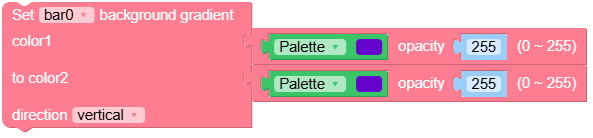
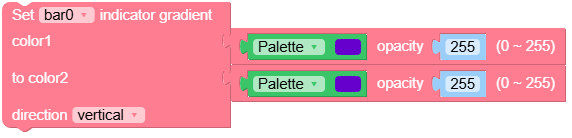
- set_bg_grad_color(color, opa, grad_color, grad_opd, grad_dir, part)
Set the background gradient color of the bar.
- Parameters:
color (int) – The start color of the gradient, can be an integer (RGB).
opa (int) – The opacity of the start color (0-255).
grad_color (int) – The end color of the gradient, can be an integer (RGB).
grad_opd (int) – The opacity of the end color (0-255).
grad_dir (int) – The direction of the gradient (e.g., lv.GRAD_DIR.VER).
part (int) – The part of the object to apply the style to (e.g., lv.PART.MAIN).
- Returns:
None
UiFlow2 Code Block:
MicroPython Code Block:
bar.set_bg_grad_color(0x00FF00, 255, 0xFF0000, 255, lv.GRAD_DIR.HOR, lv.PART.MAIN | lv.STATE.DEFAULT)
bar.set_bg_grad_color(0x00FF00, 255, 0xFF0000, 255, lv.GRAD_DIR.HOR, lv.PART.INDICATOR | lv.STATE.DEFAULT)
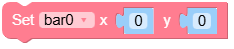
- set_pos(x, y)
Set the position of the bar.
- Parameters:
- Returns:
None
UiFlow2 Code Block:
MicroPython Code Block:
bar.set_pos(100, 100)
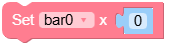
- set_x(x)
Set the x-coordinate of the bar.
- Parameters:
x (int) – The x-coordinate of the bar.
- Returns:
None
UiFlow2 Code Block:
MicroPython Code Block:
bar.set_x(100)
- set_y(y)
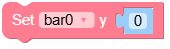
Set the y-coordinate of the bar.
- Parameters:
y (int) – The y-coordinate of the bar.
- Returns:
None
UiFlow2 Code Block:
MicroPython Code Block:
bar.set_y(100)
- set_size(width, height)
Set the size of the bar.
UiFlow2 Code Block:

MicroPython Code Block:
bar.set_size(200, 30)
- set_width(width)
Set the width of the bar.
- Parameters:
width (int) – The width of the bar.
- Returns:
None
UiFlow2 Code Block:

MicroPython Code Block:
bar.set_width(200)
- get_width()
Get the width of the bar.
- Returns:
The width of the bar.
- Return type:
UiFlow2 Code Block:

MicroPython Code Block:
width = bar.get_width()
- set_height(height)
Set the height of the bar.
- Parameters:
height (int) – The height of the bar.
- Returns:
None
UiFlow2 Code Block:

MicroPython Code Block:
bar.set_height(30)
- get_height()
Get the height of the bar.
- Returns:
The height of the bar.
- Return type:
UiFlow2 Code Block:

MicroPython Code Block:
height = bar.get_height()
- align_to(obj, align, x, y)
Align the bar to another object.
- Parameters:
- Returns:
None
UiFlow2 Code Block:

MicroPython Code Block:
bar.align_to(page_0, lv.ALIGN.CENTER, 0, 0)
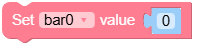
- set_value(value, anim=False)
Set the current value of the bar.
- Parameters:
- Returns:
None
- Return type:
None
UiFlow2 Code Block:
MicroPython Code Block:
bar.set_value(75, True)
