Atomic Echo Base
The following products are supported:
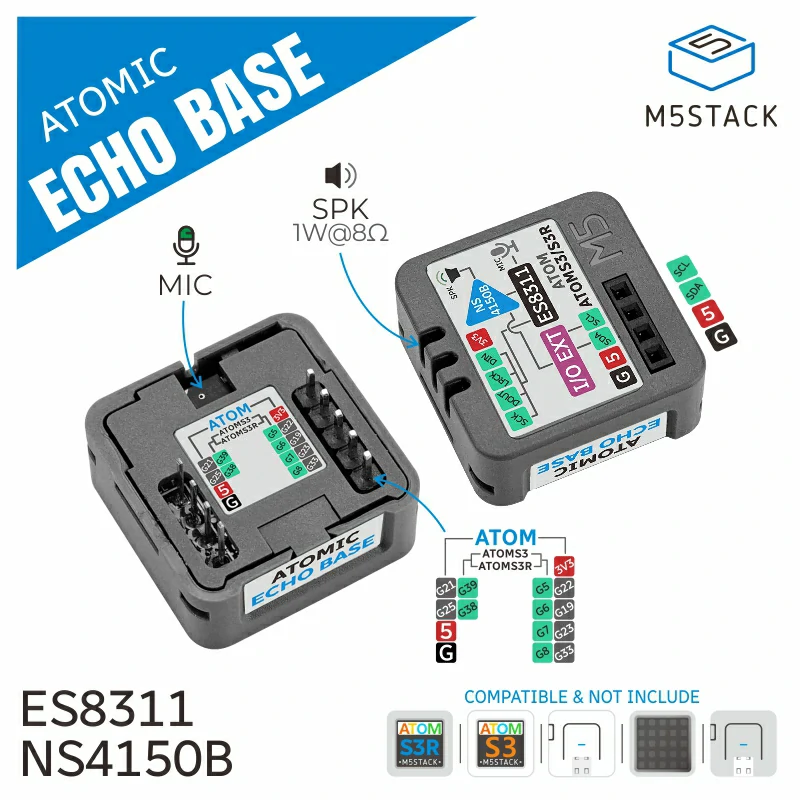
Below is the detailed support for Atomic Echo Base on the host:
Controller |
Atomic Echo Base |
|---|---|
Atom Echo |
⭕ |
Atom Lite |
✅ |
Atom Matrix |
✅ |
AtomS3 |
✅ |
AtomS3 Lite |
✅ |
AtomS3R |
✅ |
AtomS3R-CAM |
✅ |
AtomS3R-Ext |
✅ |
UiFlow2 Example
Play WAV file
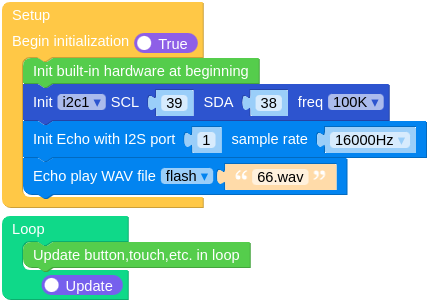
Open the atoms3_play_wav_example.m5f2 project in UiFlow2.
This example reads an audio file from the file system and plays it.
UiFlow2 Code Block:
Example output:
None
Playback Controls
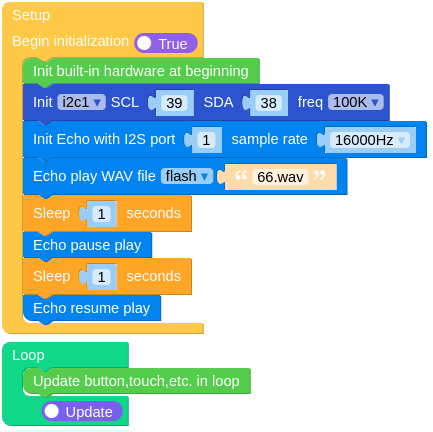
Open the atoms3_playback_controls_example.m5f2 project in UiFlow2.
This example demonstrates how to control playback using the AtomicEchoBase class.
Play the audio for 1 second, pause for 1 second, and then resume playing.
UiFlow2 Code Block:
Example output:
None
Record Audio
Open the atoms3_record_audio_example.m5f2 project in UiFlow2.
This example records audio from the microphone and saves it to a PCM buffer, then plays it out through the speaker.
UiFlow2 Code Block:

Example output:
None
MicroPython Example
Play WAV file
This example reads an audio file from the file system and plays it.
MicroPython Code Block:
 1# SPDX-FileCopyrightText: 2025 M5Stack Technology CO LTD
 2#
 3# SPDX-License-Identifier: MIT
 4
 5import os, sys, io
 6import M5
 7from M5 import *
 8from hardware import I2C
 9from hardware import Pin
10from base import AtomicEchoBase
11import time
12
13
14i2c1 = None
15base_echo = None
16
17
18def setup():
19    global i2c1, base_echo
20
21    M5.begin()
22    i2c1 = I2C(1, scl=Pin(39), sda=Pin(38), freq=100000)
23    base_echo = AtomicEchoBase(i2c1, 0x18, 1, 16000, 8, 6, 7, 5)
24    base_echo.play_wav_file("/flash/res/audio/66.wav")
25    time.sleep(1)
26    base_echo.pause()
27    time.sleep(1)
28    base_echo.resume()
29
30
31def loop():
32    global i2c1, base_echo
33    M5.update()
34
35
36if __name__ == "__main__":
37    try:
38        setup()
39        while True:
40            loop()
41    except (Exception, KeyboardInterrupt) as e:
42        try:
43            from utility import print_error_msg
44
45            print_error_msg(e)
46        except ImportError:
47            print("please update to latest firmware")
Example output:
None
Playback Controls
This example demonstrates how to control playback using the AtomicEchoBase class.
Play the audio for 1 second, pause for 1 second, and then resume playing.
MicroPython Code Block:
 1# SPDX-FileCopyrightText: 2025 M5Stack Technology CO LTD
 2#
 3# SPDX-License-Identifier: MIT
 4
 5import os, sys, io
 6import M5
 7from M5 import *
 8from hardware import I2C
 9from hardware import Pin
10from base import AtomicEchoBase
11import time
12
13
14i2c1 = None
15base_echo = None
16
17
18def setup():
19    global i2c1, base_echo
20
21    M5.begin()
22    i2c1 = I2C(1, scl=Pin(39), sda=Pin(38), freq=100000)
23    base_echo = AtomicEchoBase(i2c1, 0x18, 1, 16000, 8, 6, 7, 5)
24    base_echo.play_wav_file("/flash/res/audio/66.wav")
25    time.sleep(1)
26    base_echo.pause()
27    time.sleep(1)
28    base_echo.resume()
29
30
31def loop():
32    global i2c1, base_echo
33    M5.update()
34
35
36if __name__ == "__main__":
37    try:
38        setup()
39        while True:
40            loop()
41    except (Exception, KeyboardInterrupt) as e:
42        try:
43            from utility import print_error_msg
44
45            print_error_msg(e)
46        except ImportError:
47            print("please update to latest firmware")
Example output:
None
Record Audio
This example records audio from the microphone and saves it to a PCM buffer, then plays it out through the speaker.
MicroPython Code Block:
 1# SPDX-FileCopyrightText: 2025 M5Stack Technology CO LTD
 2#
 3# SPDX-License-Identifier: MIT
 4
 5import os, sys, io
 6import M5
 7from M5 import *
 8from hardware import I2C
 9from hardware import Pin
10from base import AtomicEchoBase
11
12
13i2c1 = None
14base_echo = None
15
16
17def setup():
18    global i2c1, base_echo
19
20    M5.begin()
21    i2c1 = I2C(1, scl=Pin(39), sda=Pin(38), freq=100000)
22    base_echo = AtomicEchoBase(i2c1, 0x18, 1, 16000, 8, 6, 7, 5)
23    base_echo.record(rate=16000, bits=16, channel=AtomicEchoBase.STEREO, duration=500)
24    base_echo.play_raw(
25        base_echo.pcm_buffer, rate=16000, bits=16, channel=AtomicEchoBase.STEREO, duration=-1
26    )
27
28
29def loop():
30    global i2c1, base_echo
31    M5.update()
32
33
34if __name__ == "__main__":
35    try:
36        setup()
37        while True:
38            loop()
39    except (Exception, KeyboardInterrupt) as e:
40        try:
41            from utility import print_error_msg
42
43            print_error_msg(e)
44        except ImportError:
45            print("please update to latest firmware")
Example output:
None
AtomicEchoBase
- class base.echo.AtomicEchoBase(*args, **kwargs)
Bases:
objectCreate an AtomicEchoBase object.
- Parameters:
i2c (I2C) – I2C object
address (int) – The I2C address of the ES8311. Default is 0x18.
i2s_port (int) – The I2S port number. Default is 1.
sample_rate (int) – The sample rate of the audio. Default is 16000.
i2s_sck (int) – The I2S SCK pin. Default is -1.
i2s_ws (int) – The I2S WS pin. Default is -1.
i2s_di (int) – The I2S DI pin. Default is -1.
i2s_do (int) – The I2S DO pin. Default is -1.
UIFLOW2:

Micropython:
from hardware import I2C
from hardware import Pin
from base import AtomicEchoBase

# atom echo
i2c1 = I2C(1, scl=Pin(21), sda=Pin(25), freq=100000)
base_echo = AtomicEchoBase(i2c1, address=0x18, i2s_port=1, sample_rate=44100, i2s_sck=33, i2s_ws=19, i2s_di=23, i2s_do=22)

# atom lite
i2c1 = I2C(1, scl=Pin(21), sda=Pin(25), freq=100000)
base_echo = AtomicEchoBase(i2c1, address=0x18, i2s_port=1, sample_rate=44100, i2s_sck=33, i2s_ws=19, i2s_di=23, i2s_do=22)

# atom matrix
i2c1 = I2C(1, scl=Pin(21), sda=Pin(25), freq=100000)
base_echo = AtomicEchoBase(i2c1, address=0x18, i2s_port=1, sample_rate=44100, i2s_sck=33, i2s_ws=19, i2s_di=23, i2s_do=22)

# atoms3 / atoms3 lite
i2c1 = I2C(1, scl=Pin(39), sda=Pin(38), freq=100000)
base_echo = AtomicEchoBase(i2c1, address=0x18, i2s_port=1, sample_rate=44100, i2s_sck=8, i2s_ws=6, i2s_di=7, i2s_do=5)

# atoms3r / atoms3r-cam / atoms3-ext
i2c1 = I2C(1, scl=Pin(39), sda=Pin(38), freq=100000)
base_echo = AtomicEchoBase(i2c1, address=0x18, i2s_port=1, sample_rate=44100, i2s_sck=8, i2s_ws=6, i2s_di=7, i2s_do=5)

base_echo.speaker.tone(2000, 1000)
base_echo.speaker.playWavFile('res/audio/66.wav')
- MONO = 1
Mono
- STEREO = 2
Stereo
- play_wav_file(file)
Play a WAV file.
- Parameters:
file (str) – The path of the WAV file to play.
- Returns:
None
- Return type:
None
UiFlow2 Code Block:

MicroPython Code Block:
base_echo.play_wav_file("/flash/res/audio/test.wav")
- tone(freq, duration)
Play simple tone sound.
- Parameters:
- Returns:
None
- Return type:
None
UiFlow2 Code Block:

MicroPython Code Block:
base_echo.tone(2000, 50)
- play_wav(buf, duration=-1)
Play a WAV buffer.
- Parameters:
- Returns:
None
- Return type:
None
UiFlow2 Code Block:

MicroPython Code Block:
base_echo.play_wav(wav_buffer, duration=1000)
- play_raw(buf, rate=16000, bits=16, channel=2, duration=-1)
Play a pcm buffer.
- Parameters:
buf (bytes) – The PCM buffer to play.
rate (int) – Sample rate (default is 16000).
bits (int) – Bit depth (default is 16).
channel (int) – Number of channels (default is 2).
duration (int) – Duration of the PCM buffer in milliseconds. when duration is -1, it will play until stopped. (default is -1).
- Returns:
None
- Return type:
None
UiFlow2 Code Block:

MicroPython Code Block:
base_echo.play_raw(pcm_buffer, rate=16000, bits=16, channel=2, duration=1000)
- pause()
Pause the playback.
UiFlow2 Code Block:

MicroPython Code Block:
audio.tone(2000, 100)
time.sleep(0.05)
base_echo.pause()
time.sleep(0.05)
base_echo.resume()
- Return type:
None
- resume()
Resume the playback.
UiFlow2 Code Block:

MicroPython Code Block:
audio.tone(2000, 100)
time.sleep(0.05)
base_echo.pause()
time.sleep(0.05)
base_echo.resume()
- stop()
Stop the playback.
UiFlow2 Code Block:

MicroPython Code Block:
audio.tone(2000, 100)
time.sleep(0.05)
base_echo.stop()
- get_volume()
Get the speaker volume level.
- Returns:
The volume level (0-100).
- Return type:
UiFlow2 Code Block:

MicroPython Code Block:
base_echo.get_volume()
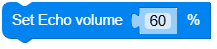
- set_volume(volume)
Set the speaker volume level.
- Parameters:
volume (int) – The volume level (0-100).
UiFlow2 Code Block:
MicroPython Code Block:
base_echo.set_volume(50)
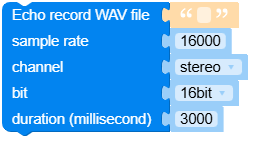
- record_wav_file(path, rate=16000, bits=16, channel=2, duration=3000)
Record audio to a WAV file.
- Parameters:
UiFlow2 Code Block:
MicroPython Code Block:
base_echo.record_wav_file("/flash/res/audio/test.wav", rate=16000, bits=16, channel=2, duration=3000)
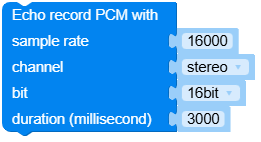
- record(rate=16000, bits=16, channel=2, duration=3000)
Record audio to a PCM buffer.
- Parameters:
UiFlow2 Code Block:
MicroPython Code Block:
base_echo.record(rate=16000, bits=16, channel=2, duration=3000)
