M5Keyboard
M5Keyboard is a widget that can be used to create virtual keyboards in the user interface. It provides an on-screen keyboard that can be used for text input with support for different keyboard modes and layouts.
UiFlow2 Example
basic keyboard
Open the cores3_keyboard_basic_example.m5f2 project in UiFlow2.
This example demonstrates how to create a virtual keyboard and connect it to a text input area.
UiFlow2 Code Block:
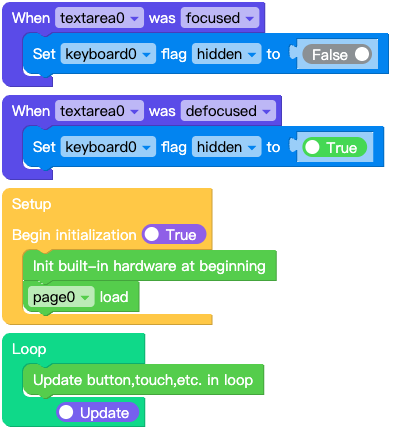
Example output:
None
MicroPython Example
basic keyboard
This example demonstrates how to create a virtual keyboard and connect it to a text input area.
MicroPython Code Block:
 1# SPDX-FileCopyrightText: 2025 M5Stack Technology CO LTD
 2#
 3# SPDX-License-Identifier: MIT
 4
 5import os, sys, io
 6import M5
 7from M5 import *
 8import m5ui
 9import lvgl as lv
10
11
12page0 = None
13textarea0 = None
14keyboard0 = None
15
16
17def textarea0_focused_event(event_struct):
18    global page0, textarea0, keyboard0
19    keyboard0.set_flag(lv.obj.FLAG.HIDDEN, False)
20
21
22def textarea0_defocused_event(event_struct):
23    global page0, textarea0, keyboard0
24    keyboard0.set_flag(lv.obj.FLAG.HIDDEN, True)
25
26
27def textarea0_event_handler(event_struct):
28    global page0, textarea0, keyboard0
29    event = event_struct.code
30    if event == lv.EVENT.FOCUSED and True:
31        textarea0_focused_event(event_struct)
32    if event == lv.EVENT.DEFOCUSED and True:
33        textarea0_defocused_event(event_struct)
34    return
35
36
37def setup():
38    global page0, textarea0, keyboard0
39
40    M5.begin()
41    Widgets.setRotation(1)
42    m5ui.init()
43    page0 = m5ui.M5Page(bg_c=0xFFFFFF)
44    textarea0 = m5ui.M5TextArea(
45        text="textarea0",
46        placeholder="Placeholder...",
47        x=10,
48        y=30,
49        w=300,
50        h=70,
51        font=lv.font_montserrat_14,
52        bg_c=0xFFFFFF,
53        border_c=0xE0E0E0,
54        text_c=0x212121,
55        parent=page0,
56    )
57    keyboard0 = m5ui.M5Keyboard(
58        x=0,
59        y=120,
60        w=320,
61        h=120,
62        mode=lv.keyboard.MODE.TEXT_LOWER,
63        target_textarea=textarea0,
64        parent=page0,
65    )
66
67    textarea0.add_event_cb(textarea0_event_handler, lv.EVENT.ALL, None)
68
69    page0.screen_load()
70
71
72def loop():
73    global page0, textarea0, keyboard0
74    M5.update()
75
76
77if __name__ == "__main__":
78    try:
79        setup()
80        while True:
81            loop()
82    except (Exception, KeyboardInterrupt) as e:
83        try:
84            m5ui.deinit()
85            from utility import print_error_msg
86
87            print_error_msg(e)
88        except ImportError:
89            print("please update to latest firmware")
Example output:
None
API
M5Keyboard
- class m5ui.keyboard.M5Keyboard(*args, **kwargs)
Bases:
keyboardCreate a keyboard widget.
- Parameters:
x (int) – The x position of the keyboard.
y (int) – The y position of the keyboard.
w (int) – The width of the keyboard.
h (int) – The height of the keyboard.
mode (int) – The keyboard mode, default is lv.keyboard.MODE.TEXT_LOWER.
target_textarea (lv.obj) – The target textarea to link with the keyboard.
parent (lv.obj) – The parent object, default is the active screen.
UiFlow2 Code Block:
None
MicroPython Code Block:
import m5ui
import lvgl as lv

m5ui.init()
keyboard = m5ui.M5Keyboard(x=0, y=120, w=320, h=100, target_textarea=None, parent=page0)
- set_flag(flag, value)
Set a flag on the object. If
valueis True, the flag is added; if False, the flag is removed.- Parameters:
- Returns:
None
UiFlow2 Code Block:

MicroPython Code Block:
keyboard_0.set_flag(lv.obj.FLAG.HIDDEN, True)
- toggle_flag(flag)
Toggle a flag on the object. If the flag is set, it is removed; if not set, it is added.
- Parameters:
flag (int) – The flag to toggle.
- Returns:
None
UiFlow2 Code Block:

MicroPython Code Block:
keyboard_0.toggle_flag(lv.obj.FLAG.HIDDEN)
- set_state(state, value)
Set the state of the keyboard. If
valueis True, the state is set; if False, the state is unset.- Parameters:
- Returns:
None
UiFlow2 Code Block:

MicroPython Code Block:
keyboard_0.set_state(lv.STATE.PRESSED, True)
- toggle_state(state)
Toggle the state of the keyboard. If the state is set, it is unset; if not set, it is set.
- Parameters:
state (int) – The state to toggle.
- Returns:
None
UiFlow2 Code Block:

MicroPython Code Block:
keyboard_0.toggle_state(lv.STATE.PRESSED)
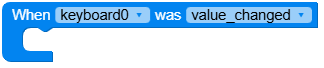
- add_event_cb(handler, event, user_data)
Add an event callback to the keyboard. The callback will be called when the specified event occurs.
- Parameters:
handler (function) – The callback function to call.
event (int) – The event to listen for.
user_data (Any) – Optional user data to pass to the callback.
- Returns:
None
UiFlow2 Code Block:
MicroPython Code Block:
def keyboard_0_value_changed_event(event_struct):
    global page0, textarea0
    print("Key pressed")

def keyboard_0_ready_event(event_struct):
    global page0, textarea0
    print("Ready")

def keyboard_0_event_handler(event_struct):
    event = event_struct.code
    if event == lv.EVENT.VALUE_CHANGED:
        keyboard_0_value_changed_event(event_struct)
    elif event == lv.EVENT.READY:
        keyboard_0_ready_event(event_struct)
    return

keyboard_0.add_event_cb(keyboard_0_event_handler, lv.EVENT.ALL, None)
- set_textarea(textarea)
Set the text area that this keyboard should control. When keys are pressed, the text will be entered into the specified text area.
- Parameters:
textarea (lv.textarea) – The text area object to connect to the keyboard.
- Returns:
None
UiFlow2 Code Block:

MicroPython Code Block:
keyboard_0.set_textarea(textarea_0)
- get_textarea()
Get the text area that is currently connected to this keyboard.
- Returns:
The connected text area object, or None if no text area is connected.
- Return type:
lv.textarea or None
UiFlow2 Code Block:

MicroPython Code Block:
ta = keyboard_0.get_textarea()
- set_mode(mode)
Set the keyboard mode to display different keyboard layouts.
- Parameters:
mode (int) – The keyboard mode to set.
- Returns:
None
Available modes include:
lv.keyboard.MODE.TEXT_LOWER: 0.
lv.keyboard.MODE.TEXT_UPPER: 1.
lv.keyboard.MODE.SYMBOL: 2.
lv.keyboard.MODE.NUMBER: 3.
UiFlow2 Code Block:

MicroPython Code Block:
keyboard_0.set_mode(lv.keyboard.MODE.TEXT_LOWER)
- get_mode()
Get the current keyboard mode.
- Returns:
The current keyboard mode.
- Return type:
Keyboard modes include:
lv.keyboard.MODE.TEXT_LOWER: 0.
lv.keyboard.MODE.TEXT_UPPER: 1.
lv.keyboard.MODE.SYMBOL: 2.
lv.keyboard.MODE.NUMBER: 3.
UiFlow2 Code Block:

MicroPython Code Block:
mode = keyboard_0.get_mode()
- set_popovers(en)
Enable or disable popovers for the keyboard. Popovers are additional UI elements that can be displayed when certain keys are pressed.
- Parameters:
en (bool) – If True, popovers are enabled; if False, they are disabled.
- Returns:
None
UiFlow2 Code Block:

MicroPython Code Block:
keyboard_0.set_popovers(True)
- get_selected_button()
Get the index of the last released button. This can be useful to determine which key was last pressed.
- Returns:
index of the last released button.
- Return type:
UiFlow2 Code Block:

MicroPython Code Block:
btn = keyboard_0.get_selected_button()
- get_button_text(btn_id)
Get the text of a button by its index.
UiFlow2 Code Block:

MicroPython Code Block:
keyboard_0.get_button_text(3)
- set_pos(x, y)
Set the position of the keyboard.
- Parameters:
- Returns:
None
UiFlow2 Code Block:

MicroPython Code Block:
keyboard_0.set_pos(100, 100)
- set_x(x)
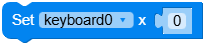
Set the x-coordinate of the keyboard.
- Parameters:
x (int) – The x-coordinate of the keyboard.
- Returns:
None
UiFlow2 Code Block:
MicroPython Code Block:
keyboard_0.set_x(100)
- set_y(y)
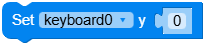
Set the y-coordinate of the keyboard.
- Parameters:
y (int) – The y-coordinate of the keyboard.
- Returns:
None
UiFlow2 Code Block:
MicroPython Code Block:
keyboard_0.set_y(100)
- set_size(width, height)
Set the size of the keyboard.
- Parameters:
- Returns:
None
UiFlow2 Code Block:

MicroPython Code Block:
keyboard_0.set_size(300, 200)
- set_width(width)
Set the width of the keyboard.
- Parameters:
width (int) – The width of the keyboard.
- Returns:
None
UiFlow2 Code Block:

MicroPython Code Block:
keyboard_0.set_width(300)
- get_width()
Get the width of the keyboard.
- Returns:
The width of the keyboard.
- Return type:
UiFlow2 Code Block:

MicroPython Code Block:
width = keyboard_0.get_width()
- set_height(height)
Set the height of the keyboard.
- Parameters:
height (int) – The height of the keyboard.
- Returns:
None
UiFlow2 Code Block:

MicroPython Code Block:
keyboard_0.set_height(200)
- get_height()
Get the height of the keyboard.
- Returns:
The height of the keyboard.
- Return type:
UiFlow2 Code Block:

MicroPython Code Block:
height = keyboard_0.get_height()
- align_to(obj, align, x, y)
Align the keyboard to another object.
- Parameters:
- Returns:
None
UiFlow2 Code Block:

MicroPython Code Block:
keyboard_0.align_to(page_0, lv.ALIGN.BOTTOM_MID, 0, -10)