SHT4X
SHT4X measures temperature and relative humidity.
Supported controllers:
Controller |
SHT4X |
|---|---|
M5PaperColor |
✔ |
UiFlow2 Example
get temperature and humidity
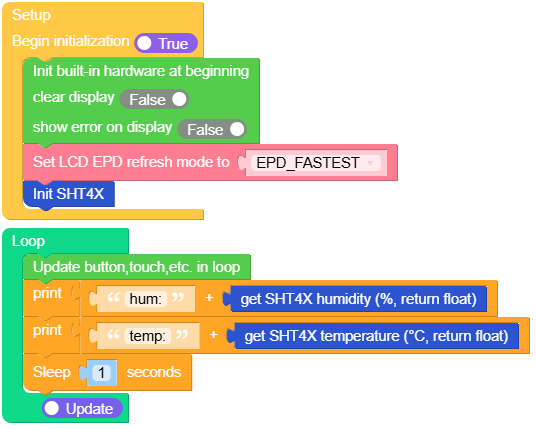
This example initializes the onboard SHT4X sensor and reads the temperature and relative humidity.
Open the sht4x_papercolor_example.m5f2 project in UiFlow2.
UiFlow2 Code Block:
Example output:
None
MicroPython Example
get temperature and humidity
This example reads temperature and relative humidity from the onboard SHT4X sensor on M5PaperColor.
MicroPython Code Block:
 1# SPDX-FileCopyrightText: 2026 M5Stack Technology CO LTD
 2#
 3# SPDX-License-Identifier: MIT
 4
 5import os, sys, io
 6import M5
 7from M5 import *
 8from hardware import SHT4X
 9import time
10
11
12sht4x = None
13
14
15def setup():
16    global sht4x
17
18    M5.begin({"clear_display": False})
19    Widgets.setRotation(1)
20
21    M5.Lcd.setEpdMode(M5.Lcd.EPDMode.EPD_FASTEST)
22    sht4x = SHT4X()
23
24
25def loop():
26    global sht4x
27    M5.update()
28    print((str("hum:") + str((sht4x.get_humidity()))))
29    print((str("temp:") + str((sht4x.get_temperature()))))
30    time.sleep(1)
31
32
33if __name__ == "__main__":
34    try:
35        setup()
36        while True:
37            loop()
38    except (Exception, KeyboardInterrupt) as e:
39        try:
40            print(e)
41        except ImportError:
42            print("please update to latest firmware")
Example output:
None
API
SHT4X
- class hardware.sht4x.SHT4X
Bases:
SHT4xCreate an onboard SHT4X sensor object.
UiFlow2 Code Block:

MicroPython Code Block:
from hardware import SHT4X

sht4x = SHT4X()
- class driver.sht4x.SHT4x(i2c, address=micropython.const)
Bases:
objectCreate an SHT4x temperature and humidity sensor object.
- Parameters:
UiFlow2 Code Block:
MicroPython Code Block:
from hardware import I2C, Pin
from driver.sht4x import SHT4x

i2c0 = I2C(0, scl=Pin(2), sda=Pin(3), freq=100000)
sht4x = SHT4x(i2c0)
- property serial_number: int
The unique 32-bit serial number of the sensor.
- Returns:
The sensor serial number.
- Return type:
- Raises:
RuntimeError – If the received serial number CRC is invalid.
MicroPython Code Block:
sht4x.serial_number
- reset()
Perform a soft reset of the sensor.
MicroPython Code Block:
sht4x.reset()
- Return type:
None
- property mode: int
The current sensor reading mode.
The mode selects both heater behavior and measurement precision. Use one of the values from
Mode, such asMode.NOHEAT_HIGHPRECISIONorMode.HIGHHEAT_100MS.- Returns:
The current measurement mode command.
- Return type:
MicroPython Code Block:
from driver.sht4x import Mode

sht4x.mode = Mode.NOHEAT_HIGHPRECISION
sht4x.mode
- property relative_humidity: float
The current relative humidity in percent RH.
- Returns:
The relative humidity, constrained to
0through100.- Return type:
UiFlow2 Code Block:

MicroPython Code Block:
sht4x.relative_humidity
- get_humidity()
Get the current relative humidity in percent RH.
- Returns:
The relative humidity, constrained to
0through100.- Return type:
UiFlow2 Code Block:
MicroPython Code Block:
sht4x.get_humidity()
- property temperature: float
The current temperature in degrees Celsius.
- Returns:
The temperature in degrees Celsius.
- Return type:
UiFlow2 Code Block:

MicroPython Code Block:
sht4x.temperature
- get_temperature()
Get the current temperature in degrees Celsius.
- Returns:
The temperature in degrees Celsius.
- Return type:
UiFlow2 Code Block:
MicroPython Code Block:
sht4x.get_temperature()
- measure()
Measure temperature and relative humidity simultaneously.
- Returns:
A tuple containing
(temperature, relative_humidity).- Return type:
- Raises:
RuntimeError – If the received measurement CRC is invalid.
MicroPython Code Block:
temperature, humidity = sht4x.measure()